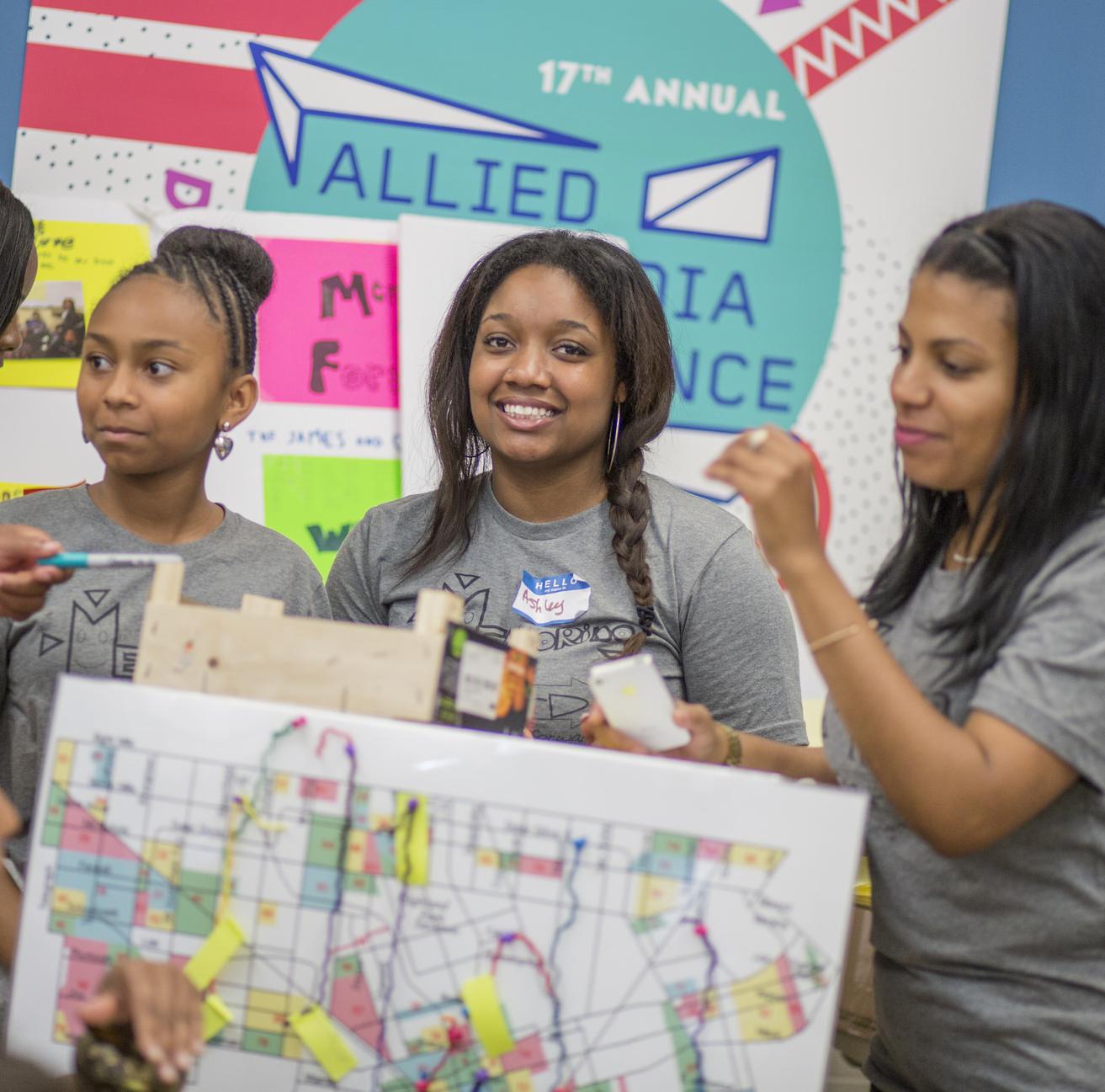
As we begin another year of AMC organizing, we are excited to highlight some of the big ideas that emerged from last year’s conference. We hope the ideas and creative strategies explored in the interviews below encourage you to propose a session for AMC2016!
The AMC is a space to come together to explore the practice of “media-based organizing,” which is any collaborative process that uses media, art, or technology to address the roots of problems and advances holistic solutions towards a more just and creative world.
In this blog post we will look at two sessions which you named as favorites in our AMC2015 feedback survey: “Speculative Cities: Becoming Place” and “The Anti Eviction Mapping Project”, sessions which explored the topic of gentrification and displacement through collaborative visioning and data mapping.
“Speculative Cities: Becoming Place”
In “Speculative Cities: Becoming Place”, presenters Althea Baird, Jenna Peters-Golden, and Ash Richards provided participants with the opportunity to use speculative fiction to explore strategies for resistance against displacement. Read on for our Q&A with the presenters.

How did you get involved with the AMC?
We met Jenny Lee (executive director of AMP) through the program Detroit Summer. We have been going to the AMC for several years, and between the three of us we’ve helped coordinate a Transformative Justice track, a Sci-fi track (“Liberation Technologies”), and the “Movement//Movement” track. The AMC makes you feel committed to going back every year, meeting new people, sharing and learning together.
How did the idea for the “Speculative Cities” session come about?
This workshop was a continuation of our “Speculative Cities” session from AMC2014 that was part of the “Creative Placemaking” track. “Speculative Cities: Becoming Place” was essentially part two of that session. In this workshop we wanted to ask the question: can we use our imaginations as a political tool to speculate on our spaces and reclaim them?
Two years ago we were thinking a lot about land and exploring how it intersects with capitalism and racism – both generally and in the specific context of our neighborhood in Philadelphia. At the time there was an influx of tax and land speculation in our community and we thought if developers and the city council can mandate tax reassessments and speculate on land, can we use the tool of speculation for visioning processes? Can we use it in a fantastic way to address gentrification, land grabbing, and cultural erasure with creative strategies? We wanted to flip the concept of land speculation and use it as a visioning tool (a tactic for remembering, preserving and transformation) as opposed to a displacement mechanism.
In this workshop we wanted to ask the question: can we use our imaginations as a political tool to speculate on our spaces and reclaim them?
Another inspiration for us was the Body Memory in the Space/Time Continuum workshop we did in 2012 with Alexis Pauline Gumbs. One of the things we focused on was place and the idea that we can use the personal and ancestral memories stored in our bodies and our imagination and our embodied spirits to speculatively understand things about our surroundings.
That concept of body memory helped us expand our approach to thinking about gentrification, because it is so much more than just thinking about buildings and physical displacement. It’s a bigger culture shift. It erases those memories and histories and cultures that make a place. In the mainstream conversation, people often define gentrification to just be about class, but it is also rooted in different forms of systematic oppression. We really wanted to drive home that point.

What were some highlights from the session?
Our approach to the session was to use the emotional and empathetic process of letter writing to share strategies for resisting and challenging the narratives of gentrification. Beyond that, we also wanted to ask how can we collectively heal from the trauma caused by the legacy of dispossession and cultural erasure, now manifesting as gentrification. We asked participants, “How do we create spaces of joy and how do we allow our communities to survive and thrive?”
The main highlight of the session was the letter writing activity, which was inspired in conversation with our comrade adrienne maree brown (of Octavia’s Brood). We asked participants to write letters from the past to the present, from the present to the future, from the future to yesterday, or any other non-linear connection. The prompt for the letter was to explore strategies of resistance against gentrification, a very open prompt allowing participants to interpret “strategy” in many different ways. One example was a letter from a participant’s grandmother who shared her experience of living as a beekeeper and farmer and her process of healing and becoming one with a place. Another was a group of future freaks that developed a glass shattering song used to deter developers from encroaching on their neighborhood. We broke into small groups to look at the letters and identified patterns among them. The last part was a big group reflection.
Our approach to the session was to use the emotional and empathetic process of letter writing to share strategies for resisting and challenging the narratives of gentrification.
Letter writing is an activity that allows us to be beautiful and creative and deep and romantic and sad and personal. It is a way we can transmit information and ideas and longing. Letter writing as an ephemeral form embodies the feelings we were trying to capture. Especially what we lose when we lose neighborhoods and what we long for in terms of reclaiming them.
Another highlight was our fourth “facilitator” named “ORCHIDD,” short for Organizing Resistant Channels in Development Dystopia. ORCHIDD joined the session through audio wired through the room. ORCHIDD created herself as a feeling-based program that developed as a glitch out of the colonizing practices of urban development. So if the city is a system, then ORCHIDD is a glitch in that system.
What were some of the takeaways from the session?
A major takeaway for us was that connecting with each other on an emotional level is very important – that’s what is key in this movement work. It felt like people were connecting with themselves through the letters but also with their past selves and future selves – the space allowed us to practice this type of connection. If we are committed to creating spaces of joy, communal living, or autonomy, can we do that without knowing each other?
People responded very emotionally to the activity. We integrated so many different types of thinking and feeling and welcomed people’s whole selves into the space. When you create a space that brings your whole body into the work, it’s going to be emotional. A lot of times we feel the need to separate our spirit and pain and love from the hard work of organizing. It was beautiful to see how people adapted to this kind of space.
We are also creating a zine that compiles some of the letters written in the session as a way to remember and continue to imagine together. We’ll put it online at spatialjusticelab.net when it is done.
What’s Next? How will this work continue post-AMC?
This workshop comes out of the ongoing work we are involved in our communities in different ways, such as housing justice work, creating spiritual culture and media, and doing political education in land rights and racial justice in Philadelphia. We are planning to do an expanded version of “Speculative Cities” in our neighborhood and explore ways to develop more concrete strategies from the workshop. We met a lot of people after the workshop at the AMC who asked us to present it in their communities or exchange curriculum with them. Hopefully people walked away from the workshop inspired to borrow activities and facilitate more of these conversations in their own communities. It is a continual work in progress and it will evolve and adapt and shift in different contexts.
“The Anti Eviction Mapping Project: Data-viz and Storytelling”
In “The Anti Eviction Mapping Project”, presenters Manissa Maharawal, Erin McElroy, Karyn Smoot, Andrew Szeto, Manon Vergerio, and Carla Wojczuk taught participants how to map out gentrification trends through data visualization, oral history. and participatory research. Read on for our interview with Karyn and Erin.

What is the Anti Eviction Mapping Project?
It is a data-visualization, data analysis, and digital storytelling collective documenting displacement in the San Francisco Bay Area. There are two parts to the project: the qualitative and quantitative work. The qualitative part is the “Narratives of Displacement: Oral History Project” living archive of stories about neighborhood changes, which we’ve been working on for two years now. The quantitative part involves the production of data visualizations based on demographic and eviction data in the Bay Area.
At the AMC we were excited to showcase the work we had been doing in a way where we could pair the data visualizations with the oral histories. We compiled a zine that was a compilation of transcripts of oral histories, poems, essays and photos that people had submitted as part of the project. We released the zine at the AMC as part of our session. While it is not online, it is available at local bookstores such as Modern Times in the Bay Area.
Why did you want to bring this work to the AMC? What was your experience at the conference?
The AMC felt like a great opportunity to network with other people doing similar community-based work across the country.
All of our maps and the data we release are in relationship with community-based organizing. For instance, recently we created a timeline of displacement and development on Yerba Buena Island in collaboration with over 100 tenants facing imminent eviction for San Francisco to build 285 luxury units in their place.
Such community based collaboration is something the AMC values and the Research Justice track in particular takes seriously. At the AMC we were able to highlight both the qualitative and quantitative data and it was exciting to be able to share that process in our session.
At the AMC members of our group also participated in the “Groundswell: Oral History for Movement Building” network gathering, which was a space to explore oral history practices, talk about ethics, and learn from people of all backgrounds and experiences. We also attended a session called “Data Visualization for the Movement” where we were able to learn new tools and share our experiences in mapping. We were introduced to specific technologies like Vojo and LittleSis that we began to integrate into our work coming back from the AMC, for instance in making a new power map of players behind the Yerba Buena Island development.
What were some highlights from the session?
We began by briefly explaining how we collect data and make maps, and then we shared 10 different maps and paired them with oral histories to highlight the human experience of what was represented on the map. It was important to include the voices and and politics of those being impacted in multiple ways through the eviction crisis, having them speak for themselves and not simply having us attempt to explain their lives.
For example, if we showed a map about police violence, we paired it with the story of someone losing a family member to police violence, such as the parents of Alex Nieto, who was recently murdered by the SFPD. If we showed a map of San Francisco Ellis Act evictions, we included the narrative of someone fighting such an eviction and facing homelessness. We also showed a map of wins through direct action, paired with a collaborative interactive video piece featuring the story of Benito Santiago which we recently made with the LandOfOpportunity experimental web platform to reveal the power of organizing and direct action in fighting gentrification.
It was important to include the voices and and politics of those being impacted in multiple ways through the eviction crisis, having them speak for themselves and not simply having us attempt to explain their lives.
We also asked people to share some of their stories and observations about gentrification in their neighborhoods. A lot of people were interested in how to conduct a similar project in their own city.
What were your takeaways from the session, and more broadly from the AMC?
Many participants had questions in terms of the actual “how to” behind creating these maps – we could definitely have offered a follow up session that goes into the nitty-gritty of mapmaking and conducting oral history.
For the oral history project we are continuing to interview people. We also welcomed a new member to the oral history project that we actually met at our session!
The Groundswell Network Gathering was really helpful for us in thinking through the project. For a lot of people in our project it is their first time engaging in oral history. We were excited to further explore the connections between oral history in relationship to community organizing. We got a lot of good resources and conversations at the network gathering, such as their handbook for how to do oral history. We were inspired by this tool and talked through an idea to create a handbook for our project.
We were also able to more deeply explore the relationship between gentrification and settler colonialism that is still embedded in cycles of displacement today. A few of us were at the Beehive Collective session on depicting gentrification in Detroit through visualization. After coming back to the Bay Area we worked on a map of displacement on Yerba Buena island which includes an interactive timeline starting with colonial history. It was great to see the folks at the Beehive Collective thinking and talking about that and it was a reminder to continue incorporating these histories into our project.
We have also been actively engaged in translating our website into Spanish, which was suggested by a participant in our session.
What’s next for the Anti Eviction Mapping Project?
One thing we are in conversation around is expanding the project into the East Bay and Alameda County, which includes Oakland. We are currently looking for participants for this! Email us at antievictionmap@riseup.net if you are interested in joining us!
It’s that time of year again! We’re coming up on the 18th annual Allied Media Conference, June 16 - 19 in Detroit, and we need your ideas to make this year’s conference the best yet. Artists, designers, technologists, policy advocates, media enthusiasts: we encourage you to submit a session proposal! The deadline to submit your idea is March 11, 2016.